Portable Digital Hanging Scale 50 kg: ZZDG-601A Buyer Guide
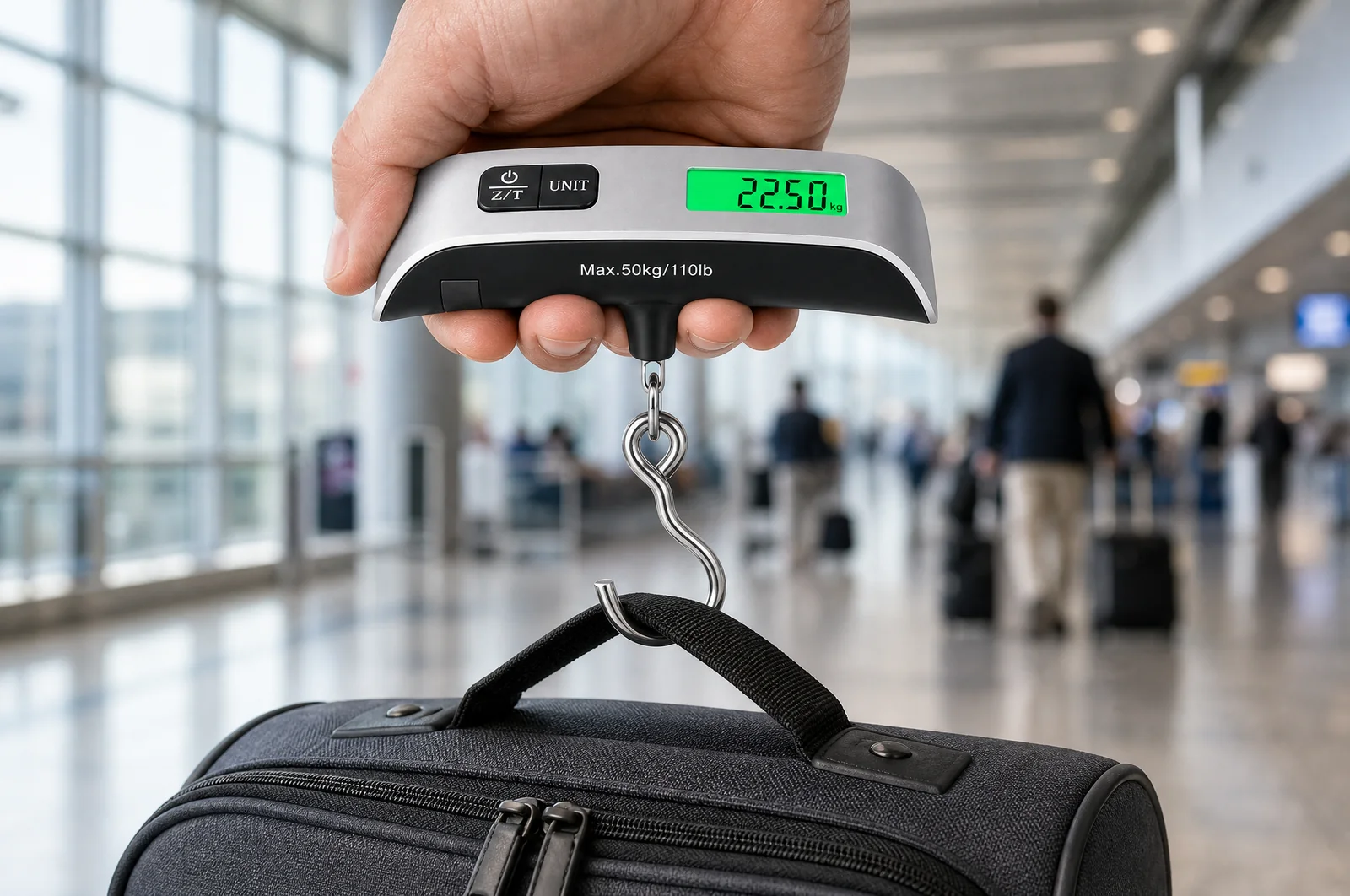
A 50 kg portable digital hanging scale with a 10 g division is a handheld hook scale used to check a suitcase before a flight or to weigh a catch on the riverbank. The ZZDG-601A is the compact model in that class from Zhezhong Weighing Apparatus Factory: 50 kg capacity, 10 g display increment, a 13 × 3.7 × 4.5 cm body in stainless steel or plastic, one CR2032 cell, kg/lb switching, an optional backlight, and OEM branding from 300 pcs.
This guide is written for buyers who have already shortlisted a hanging scale and need to confirm whether this specification fits their channel, what to negotiate before the order, and what to inspect before release. It does not replace destination-market compliance review or a third-party inspection, and it does not convert a utility scale into a legal-for-trade instrument.
Key takeaways
- 50 kg / 10 g equals 5,000 divisions. That is a fine display resolution for a handheld product, but it is a resolution figure, not an accuracy guarantee.
- This is a reference scale, not a verified instrument. If your market requires legal-for-trade weighing, this model is the wrong product, regardless of price.
- MOQ is 300 pcs, trial orders included; stock ships in 3–5 days, made-to-order runs take 15–20 days.
- Catalog FOB price is USD 1.50–2.50 per piece, before packaging upgrades, certification work or freight.
- Eight inspection checkpoints decide release: display, unit switching, weighing behaviour, hook assembly, battery contact, appearance and branding, packaging version, carton marks.
ZZDG-601A specifications at a glance
| Item | Specification |
|---|---|
| Model | ZZDG-601A |
| Product type | Portable digital hanging scale (handheld hook scale) |
| Capacity | 50 kg / 110 lb |
| Division | 10 g (0.01 kg) |
| Display | LCD, backlight optional |
| Units | kg / lb switchable |
| Body size | 13 × 3.7 × 4.5 cm |
| Material | Stainless steel or plastic |
| Power | 1 × CR2032 battery |
| Hook | Metal hanging hook |
| Functions | Power on/off, unit switch, tare / zero (Z/T), low-battery indication |
| Typical applications | Luggage and air travel, fishing and outdoor |
| MOQ | 300 pcs (trial order welcome) |
| Lead time | 3–5 days ex-stock / 15–20 days made to order |
| FOB price | USD 1.50–2.50 per piece |
| Port | Ningbo (FOB); CIF and DDP available |
| Payment | T/T, L/C, Western Union, Trade Assurance |
| Certifications | CE, RoHS; factory holds ISO 9001 |
| HS code | 8423.89 |
| Warranty | 12 months, extendable |
Full drawing, packaging options and current price breaks are on the ZZDG-601A product page.
How to read "50 kg capacity, 10 g division"
What 5,000 divisions tells you
Fifty kilograms divided by ten grams is 5,000 display steps. For a compact scale running on a coin cell, that is a demanding but achievable ratio, and it is the number that separates this model from cheaper 100 g-division hook scales in the same category. A 100 g division is fine for weighing a sack of feed or a shipping carton; it is too coarse for a suitcase where 300 g decides whether a bag is accepted at check-in.
Division is not accuracy — ask for these three numbers
A common sourcing mistake is reading "10 g division" as "±10 g accuracy". They are different specifications, and no responsible supplier should let the two be confused.
Before you approve a sample, ask the factory for:
- Linearity — the greatest deviation across the range, measured at roughly 1/3 and 2/3 of capacity, not only at a single test weight.
- Repeatability — the spread of five consecutive readings on the same load, loaded and unloaded between each reading.
- Zero drift over time — how far the display returns from zero after a ten-minute loaded period.
The ZZDG-601A product page states that units are fully calibrated and run through a 72-hour aging test before packing. That is a production claim about process, not a published accuracy class; if your channel needs documented numbers, request the test record for your order rather than accepting a generic statement.
Where 10 g actually matters
- Air travel. Most full-service carriers cap economy checked baggage at 23 kg, but the allowance depends on carrier, route and fare. A 10 g step lets a traveller pack to a deliberate margin — weigh at 22.5 kg instead of discovering a 23.4 kg bag at the counter.
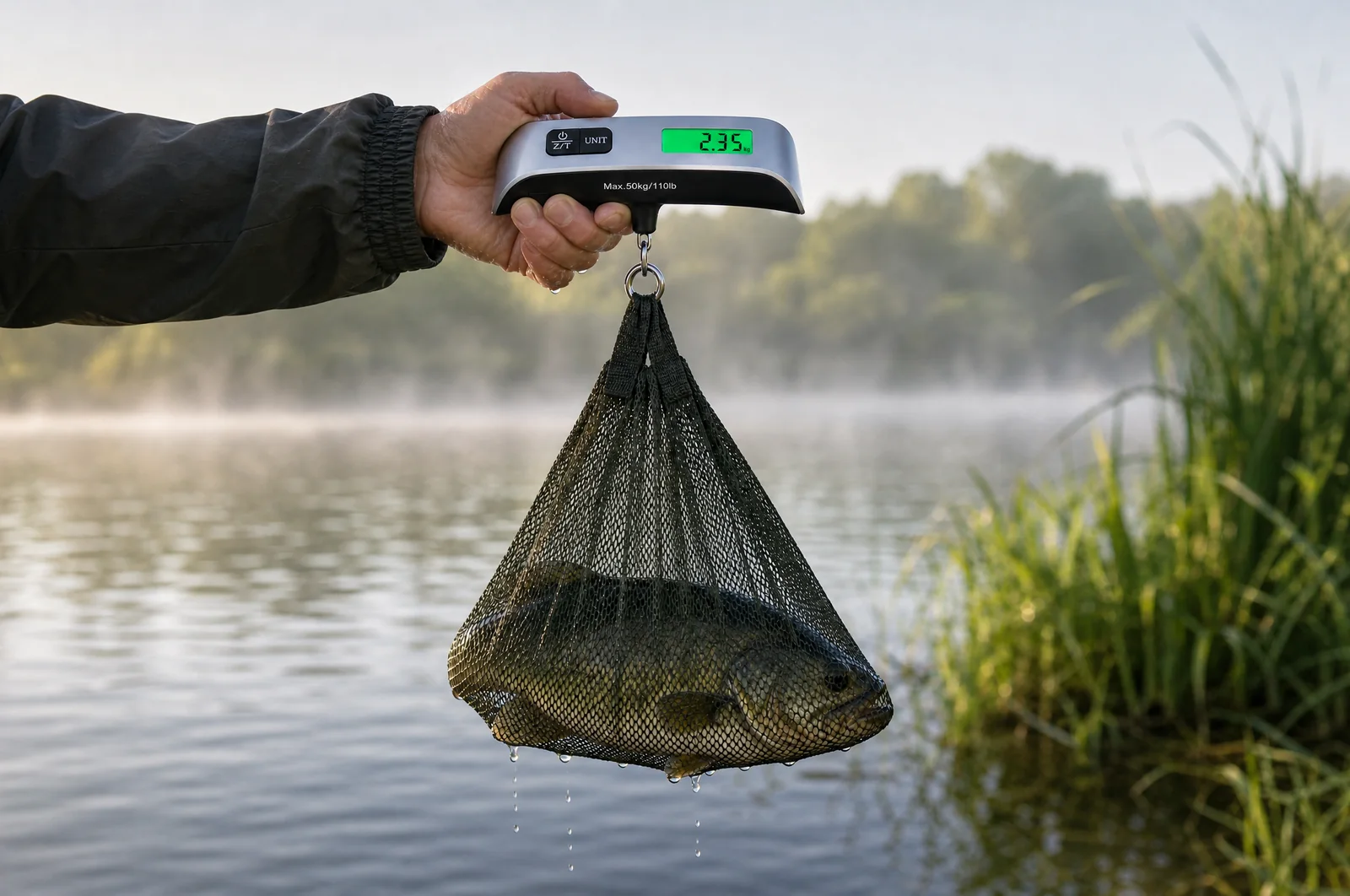
- Fishing and outdoor. A 10 g division displays 4.21 kg rather than rounding to 4.2 or 4.3, which is the difference that matters in catch records, catch-and-release logs and club or charter rules. The same hook takes a gear bag, a bait bucket or a kayak crate, so one tool covers the whole trip.
- Travel-retail demonstration. A hook scale is the easiest product in the category to demonstrate at the shelf: hand it to the shopper with a filled sample bag and the benefit lands in seconds. That is why airport, luggage and travel-accessory retailers stock this format rather than a platform scale.
It is not a legal-for-trade instrument
Hanging scales of this type are reference instruments. They are not type-approved or verified for commercial transactions where the weighed value becomes a price. In the EU, that role is regulated by Directive 2014/31/EU on non-automatic weighing instruments; internationally, the metrological requirements sit in OIML R 76 (OIML). If your customer needs certified trade weighing, specify a verified platform or bench scale instead, and treat this model as a consumer and utility product.
Who buys a 50 kg hanging scale — and who should buy something else
| Buyer type | Typical use | What to confirm before ordering |
|---|---|---|
| Travel-retail and airport concession buyers | Impulse purchase next to luggage, adapters and travel accessories | Packaging footprint, shelf-ready box, multi-language manual, retail price point |
| E-commerce and marketplace sellers | Luggage-scale listings on Amazon, eBay, regional marketplaces | Barcode/FNSKU labelling, poly-bag or color box, drop-test protection |
| Promotional and corporate-gift programs | Airline, insurer, tour-operator giveaways | Logo method, gift box, deadline-driven delivery window |
| Fishing tackle and outdoor distributors | Catch and gear weighing | Hook aperture, water resistance expectations, packaging durability |
| Travel-accessory wholesalers | Assortment filler beside luggage, adapters and travel accessories | Carton quantity, mixed-carton rules, price point per SKU |
| Hardware and general-merchandise distributors | Mixed-container filler SKUs | Carton quantity, mixed-carton rules, HS code consistency |
Buyers who need verified trade weighing, loads above 50 kg, or continuous industrial lifting duty should move up the range instead of stretching this model — see the comparison below.
Choosing between models in the same hanging-scale range
The ZZDG-601A sits in a family of seven hanging scales. The differences that matter commercially are capacity, division and price, not cosmetics.
| Model | Capacity | Division | Notable difference | Catalog FOB | MOQ |
|---|---|---|---|---|---|
| ZZDG-601A | 50 kg | 10 g | Compact 13 cm body, CR2032, lowest entry price | USD 1.50–2.50 | 300 pcs |
| ZZDG-1003A | 50 kg | 5 g (0–10 kg) / 10 g (10–50 kg) | Two-stage division for fine low-end readings | On request | 500 pcs |
| ZZDG-1014A | 50 kg | 10 g | Alternate housing and hook design | USD 2.00–3.00 | 500 pcs |
| ZZDG-1016A | 40 / 50 kg | 100 g | Tare and hold functions for trade use | USD 1.00–2.50 | 500 pcs |
| ZZDG-401A | 200 / 300 kg | 100 / 300 g | Crane-style body for overhead loads | USD 5.00–6.50 | 300 pcs |
| ZZDG-801-1 | 500 kg / 1 t | 100 / 200 g | Heavy-duty crane scale | USD 23.00–26.50 | 50 pcs |
Three practical rules for the selection:
- Resolution beats capacity for luggage programs. If the end user weighs suitcases, 10 g is the entry requirement; 100 g divisions generate returns and one-star reviews.
- Capacity beats resolution when the load is rough. A 100 g division on a 50 kg scale is a deliberate trade-off: the display settles faster under load and the unit tolerates rougher handling.
- Price per unit is not price per programme. A lower FOB with a coarser division can cost more once returns, reviews and re-shipment are counted.
The wider range, including mechanical and spring options, is listed under hanging scales.
OEM and private-label options that buyers actually negotiate
Logo printing is the easy part. The items that move cost and lead time are the ones to settle in the quotation stage, not after the artwork is approved.
| Option | What it changes | Effect on order |
|---|---|---|
| Logo on housing | Pad printing on plastic, laser marking on stainless surface | Usually no MOQ increase; artwork file and position approval required |
| Color box / blister card | Retail presentation and shelf compliance | Tooling or print setup; confirm dieline before deposit |
| Manual language set | Destination-market usability and compliance labelling | Translation and layout time inside the 15–20 day window |
| Backlight | Readability in dim aircraft cabins and pre-dawn fishing | BOM change; affects unit price |
| Body material | Stainless-steel or plastic version | Different unit price, product weight and perceived quality — confirm which version the quote covers |
| Default unit at power-on | kg for most markets, lb for US retail | Firmware or packaging note; confirm before production |
| Barcode, FNSKU, carton marks | Marketplace and distributor receiving | Buyer-supplied label data must match the order, not a previous shipment |
| Gift or promotional packaging | Airline, insurer and tour-operator programs | Separate packaging version per program; mixed cartons must be prevented |
Two negotiation notes from factory experience. First, lock the packaging version to the SKU, not to the order, or a later reprint reintroduces the risk of the wrong manual inside the right box. Second, approve a production sample of the branded unit, not only of the unbranded catalog sample — logo position and print contrast behave differently on a stainless surface than on a plastic one.
The full customization workflow is described on the OEM/ODM page.
Pre-shipment inspection checklist for hanging scale orders
A hanging scale is small enough that buyers sometimes skip inspection. That is the expensive mistake: a hook that is not fully seated, a battery contact that intermittently fails, or a manual printed for the wrong SKU can each stop a container at receiving.
| # | Checkpoint | How to test | Pass criteria |
|---|---|---|---|
| 1 | Display and power-on | Insert the supplied CR2032, power on three units per carton | Backlight (if ordered) lights, no missing segments, zero stable within a few seconds |
| 2 | Unit switching | Toggle kg / lb twice on each sampled unit | Correct conversion display, no freeze, no reset |
| 3 | Weighing behaviour | Load at roughly 1/3 and 2/3 capacity with a known test weight | Reading returns to zero after unload; deviation within the tolerance agreed in the PO |
| 4 | Hook and housing assembly | Inspect hook seat, swivel, screw torque, surface finish | No play, no sharp edge, no plating defect, no cracking at the hook mount |
| 5 | Battery compartment | Open, inspect contact spring, reinsert cell | Clean contacts, correct polarity marking, cover clips securely |
| 6 | Appearance and branding | Compare against the approved golden sample and artwork | Color, logo position, print contrast, button legends match approval |
| 7 | Packaging version | Open one retail box per carton | Box, manual language, barcode and accessory set match the SKU ordered |
| 8 | Carton and marks | Check carton strength, packing quantity, marks | Quantity per carton correct, marks legible, no mixed SKUs in one carton |
Keep the inspection record usable: order number, model, quantity checked, sampling approach, functional results, appearance results, packaging results, photos where relevant, nonconformities, corrective action and the release decision. Buyers who rely only on chat confirmations have no document to fall back on when a claim appears three weeks after arrival.
The split of responsibility should also be explicit. Destination-market labelling, import duties, battery shipping documentation and retail-channel requirements sit with the buyer; the factory's inspection can only check what has been agreed in writing beforehand.
Costing: what sits between FOB and landed cost
A worked example for a 500-piece order at USD 1.80 per unit clarifies where the money actually goes.
| Cost line | Basis | Note |
|---|---|---|
| Goods | 500 × USD 1.80 | Catalog range is USD 1.50–2.50; the upper end carries a better housing or backlight |
| Packaging upgrade | Per unit, quoted separately | Color box, manual and label changes are usually the largest non-product cost |
| Inland and export handling | Per shipment (Ningbo) | Included to FOB, not beyond |
| Ocean or air freight | Per CBM / chargeable weight | Confirm pcs per carton and carton dimensions before booking |
| Duty | HS 8423.89 at destination | Rate depends on destination and origin; China-origin goods may attract additional duties — confirm with your broker |
| Battery documentation | Per shipment where required | A CR2032 is a lithium metal cell; when packed in equipment it is normally handled under the lithium battery provisions of the IATA Dangerous Goods Regulations, but requirements vary by carrier and mode — confirm with your forwarder |
| Compliance work | Per order where required | Testing or labelling specific to the destination market |
Two levers reduce landed cost without touching the unit price: raising the packing quantity per carton where carton strength allows, and consolidating packaging versions so the printer run is not split three ways.
Compliance: what applies here, and what does not
- CE and RoHS — electrical safety and hazardous-substance compliance for the EU and several other markets; certificate scope must match the exact model and battery configuration.
- REACH — relevant for EU-bound plastic and metal parts; confirm the current declaration rather than a generic statement.
- ISO 9001 — a factory-level quality management certification, not a product approval. It supports consistency claims; it does not certify the scale.
- Legal metrology (EU 2014/31/EU, OIML R 76) — not applicable to this model unless the instrument is placed on the market for trade use with the required type approval and verification. If a customer asks for a "certified" hanging scale, clarify which role it will play before quoting.
- Battery transport — see the costing table above; documentation requirements follow the cell type and the mode of transport.
Current certificates are listed on the certifications page, and warranty terms — 12 months from B/L date, extendable for OEM partners — are set out under guarantee.
What to put in your RFQ so the quote comes back right
Send these nine items in one message and the quotation normally returns within 48 hours of a complete specification:
- Model and capacity — ZZDG-601A or an alternative from the range.
- Target quantity and annual forecast, so the price break is realistic.
- Body material — stainless-steel or plastic version.
- Display — standard LCD or backlight.
- Branding — logo file, position and marking method.
- Packaging — retail box, blister, poly bag, gift box; manual languages.
- Labelling — barcode, FNSKU, carton marks, and the data file.
- Compliance — destination market and the certificates you must hold.
- Delivery — incoterm, destination port, and the date the goods must arrive, not just ship.
FAQ
What are the capacity and division of the ZZDG-601A?
The ZZDG-601A has a 50 kg (110 lb) capacity with a 10 g division, which gives 5,000 display steps across the range. It switches between kg and lb, runs on one CR2032 battery, and measures 13 × 3.7 × 4.5 cm.
Is a 10 g division the same as ±10 g accuracy?
No. The division is the smallest step the display shows; accuracy is how close a reading is to the true mass, and it is described by linearity, repeatability and drift. Ask the factory for test data at 1/3 and 2/3 of capacity instead of treating the division as an accuracy figure.
Is the ZZDG-601A legal for trade?
No. It is a reference and utility scale, not a type-approved and verified instrument. Markets that regulate commercial weighing, such as the EU under Directive 2014/31/EU, require a verified instrument for transactions where the weight determines the price.
What battery does it use, and can it ship by air?
It uses one CR2032 cell. A CR2032 is a lithium metal battery; when packed inside the device it is normally handled under the lithium battery provisions of the IATA Dangerous Goods Regulations, but the exact documentation depends on the carrier and the mode of transport. Confirm with your freight forwarder before booking.
Can I put my logo and packaging on it?
Yes. OEM and private-label work covers pad printing or laser marking, color box and blister design, manual languages, barcode and carton marks, optional backlight, and the choice of stainless-steel or plastic body. Logo work usually does not raise the MOQ, but packaging changes add setup time inside the 15–20 day production window.
What is the MOQ and lead time?
MOQ is 300 pcs, and a trial order at that quantity is accepted. Stock ships in 3–5 days; made-to-order production takes 15–20 days after deposit and artwork approval.
Can it weigh a 23 kg suitcase accurately enough for airline limits?
For practical travel use, yes. A 10 g division lets the user see a 0.1 kg step, so packing to a deliberate margin — for example 22.5 kg against a 23 kg allowance — is straightforward. Airline allowances vary by carrier, route and fare, so the traveller should confirm the limit rather than assume it.
What warranty and inspection support is included?
Every unit carries a 12-month warranty from the B/L date, extendable for OEM partners. Third-party inspection is welcome, and the factory accepts AQL-based final inspection before shipment; SGS, BV and TUV inspectors can be arranged by the buyer.
Sources and further reading
- Directive 2014/31/EU on non-automatic weighing instruments — EUR-Lex, the EU legal basis for legal-for-trade weighing instruments.
- OIML — International Organization of Legal Metrology; R 76 covers non-automatic weighing instruments.
- IATA Dangerous Goods Regulations — lithium battery packing instructions for air freight (paid publication, no public link).
- How to choose the right scale for your market — category-level buying guide covering capacity, division, certification and lead time.
Next step
Send your target quantity, body material, branding files and destination market, and Zhezhong will confirm the current price, packaging dieline and delivery window for the ZZDG-601A — request a quote and the reply normally lands within 24 hours.
Zhezhong Weighing Apparatus Factory has manufactured scales in Yongkang, Zhejiang since 1989, holds ISO 9001, CE and RoHS certification, and exports to more than 100 countries under OEM and private-label programmes.