OEM秤变更管理:样品确认后的成本与交期

A change to an OEM scale order is free in exactly one window: after the sample is approved and before materials are ordered. After that, every change has a price, and the price is set by how far the order has already travelled — material already purchased, printing plates already cut, units already assembled, cartons already printed.
This guide is written for brand owners, importers and product managers running private-label scale programs, and it is grounded in how we run OEM and ODM orders at Zhezhong: a sealed golden sample, category MOQs from 20 pcs, 30/70 payment, and a published delay-compensation clause. It covers what a change actually costs at each stage, when a new sample is genuinely required, and what to freeze before production releases. If the project is still choosing a model rather than changing one, start with how to choose the right scale for your market.
Key takeaways
- Four change windows decide the cost, and the expensive boundary is not sample approval — it is the material release.
- A change is document-only, a targeted re-check, or a full re-sample. Judging which one by "function, fit, finish or claim" prevents both over-testing and under-testing.
- Packaging is the most common half-change: the colour box gets revised while the manual, barcode, label and carton mark still carry the old version.
- Changes during production are paid in scrapped units and a moved ship date, not in a change fee.
- One change record plus one frozen file set removes most sample-to-bulk disputes before they start.
What counts as a controlled change
Use two tests. Would the end user, the retailer or the customs officer notice it? And does the QC checklist test it?
If the answer to either is yes, it belongs in the change record. That covers obvious items — capacity, graduation, housing colour, platform material, display type, logo, battery format, carton structure — and the ones buyers routinely forget:
| Change type | Examples | Commonly missed knock-on |
|---|---|---|
| Weighing performance | Capacity, graduation, sensor, platform size | Manual accuracy statement, warranty wording, retail claim |
| Appearance | Housing colour, finish, logo size and position, display bezel | Colour box render, product photos, shelf image on marketplace listing |
| Power | Battery format, rechargeable conversion, plug type, cable | Manual, warning label, packaging copy, air-freight battery documents |
| Documentation | Manual language, label wording, barcode, FNSKU, warning text | Carton mark, packing list, retailer data sheet |
| Packaging | Colour box, blister, insert, carton quantity | Carton dimensions, gross weight, container loading plan |
| Software | Firmware behaviour, unit default, app pairing, app language | Screenshots in manual, listing claims, buyer-side test script |
| Compliance scope | New function, new adapter, new market | Test report validity, CE/UKCA declaration, retest schedule |
The pattern is the same in every row: one visible change propagates into files that are owned by different people.
The four change windows
This is the part that determines who pays and how much time is lost. The same request — say, a larger logo — costs almost nothing in window 1 and real money in window 3.
| Window | Where the order stands | What is still free | What the change costs | Schedule effect |
|---|---|---|---|---|
| 0. Pre-sample | Concept, model shortlist, artwork in progress | Specification, function, packaging direction | Nothing beyond sampling | Absorbed in sampling |
| 1. Post-approval, pre-material | Golden sample sealed, PO signed, materials not yet released | Any document, artwork, manual, label, carton mark | Re-setup time only (plates, artwork, print proof) | Days, usually within the quoted lead time |
| 2. Material released, pre-production | Film, glass, cartons, printed matter ordered or cut | Nothing already purchased | Material you now own, plus re-setup; sometimes a new sample | 1–3 weeks, depending on what was cut |
| 3. In production | Units on the line, partially assembled or packed | Nothing | Scrapped or reworked units, second setup run, split shipment | Weeks; ship date moves |
| 4. Post-production, pre-shipment | Finished goods, inspection done or scheduled | Nothing | Rework or repack; re-inspection; re-make if the change is structural | Days to a full re-run |
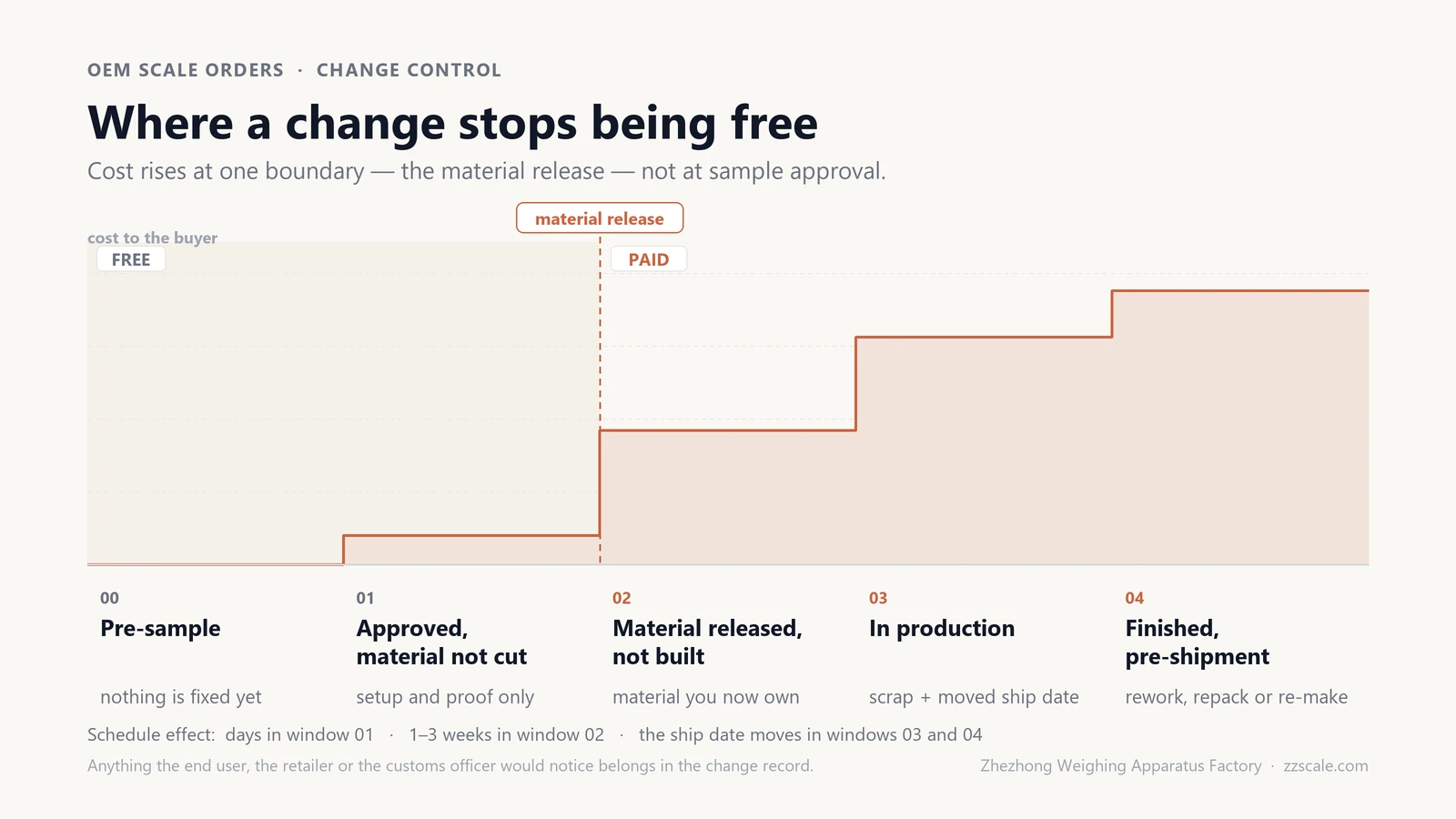
Two practical readings of this table.
First, window 1 is wider than most buyers assume. Once the golden sample is sealed, most artwork and documentation changes are still cheap, because nothing has been cut. If your brand team is still arguing about a claim sentence or a manual line, say so early and ask the supplier to hold material release — that is a normal request, and it is much cheaper than discovering the problem in window 3.
Second, window 3 has no clean exit. Once units exist, a change converts a production order into a rework order. Ask for the count before you approve anything: how many units are affected, how many can be reworked, how many are scrap. A supplier who answers that in numbers is giving you a real quote; one who answers "it depends" is telling you they have not checked the line.
Document-only, targeted re-check, or new sample?
Not every change needs a physical sample, and treating every change as a full re-sample is as wasteful as treating none of them as one. Three tiers:
| Tier | Applies when | Examples | What to do |
|---|---|---|---|
| Document-only | Nothing about the physical product, fit or claim changes | Manual wording fix, carton mark update, barcode position, label translation, packing list correction | Update the file, confirm the new version number, re-issue the QC checklist |
| Targeted re-check | One measurable attribute changes, the rest is untouched | Logo size or print position, carton quantity, an added accessory, unit default setting | Re-check that attribute in the factory with photo or video evidence; a full new sample is optional |
| Full re-sample | Function, fit, material, finish, power or compliance scope changes | Capacity or graduation, new housing colour, backlight added, rechargeable conversion, new market certification | New golden sample, buyer approval, re-sealed reference |
The judgement is not about how big the request feels. A "tiny" battery change can invalidate an air-freight battery statement; a "large" carton redesign can be document-only if the product itself is untouched.
For changes that reach the full re-sample tier, the commercial mechanics usually follow the rules already published for the first sample: sampling is charged up front and refunded against the bulk order, and the approved sample is sealed as the production reference. Confirm at the time of the change request whether that still applies to a second sample round — do not assume it carries over.
Packaging: the half-change that causes the most claims
Most sample-to-bulk disputes we see are not about the scale. They are about packaging files that were updated in one place and not the others.
A colour box revision is rarely a single file. It touches:
- the box dieline and its printed dimensions
- the manual, which usually repeats the box claims and the accuracy statement
- the rating label, barcode and any retailer-specific label
- the export carton mark and the packing list
- the marketplace listing images and bullet points, which the brand team owns
- the QC checklist, which has to test what the new file says
Freeze them as a set. When the buyer sends a revised box artwork, the correct reply is not "received" but "box v3 received; manual, label and carton mark still at v2 — please confirm which of those change too." That single sentence prevents the most common mismatch: a correct product in packaging that no longer matches the retail plan.
If carton quantity changes, three other numbers move with it — carton dimensions, gross weight and container loading. Those are not design details; they are the freight quote.
Who pays, and what to put in the proforma invoice
Published terms cover the ordinary order, not the change. Three clauses close the gap.
1. Material already purchased. If the change lands in window 2 or 3, someone owns the film, the cartons or the semi-finished units. The fair arrangement is that the buyer pays for material actually bought for this order, at cost, with the supplier's purchase record shown. Ask for that line item in writing before you approve the change — after approval it becomes a negotiation.
2. The delivery clock. We publish a delay clause — 1% discount per day of delay, capped at 10%, alongside a full refund if goods do not match the approved sample — precisely so that late shipments have a defined cost (buyer guarantees). A change requested by the buyer is a different event from a delay caused by the factory, and the proforma invoice should say so explicitly: which dates restart when an approved change is confirmed. Without that sentence, both sides argue from memory three weeks later.
3. Rework versus scrap. Decide in advance which units will be reworked and which will be scrapped, and who bears each. A rework that fails inspection becomes scrap anyway, so the decision is cheaper before the line starts than after.
Two further commercial interactions are worth checking at the same time. A change that reduces quantity can push the order below the category MOQ — 100 pcs for body scales, 200 pcs for kitchen scales, 20 pcs for hanging scales, 50 pcs for baby scales, 100 pcs for mechanical dial scales, per model on the product catalogue — and the price per unit moves with it. And a change that adds a function may change the test scope, which is a cost and a calendar item, not a paperwork item.
When certification scope changes
Certification is attached to a configuration, not to a model name. Adding a backlight, changing an adapter, converting to rechargeable, or moving a product to a new market can all pull the test report out of scope.
- CE and RoHS reports cover the configuration that was tested. A material or power change is the classic trigger for a retest; the document set per market is listed on our certifications page.
- UKCA is a separate document set for the UK market, not a relabel of the CE file.
- ISO 9001 is a factory-level system certificate, not a product approval. Ours has been held since 2010; note that ISO published the 2026 revision of the standard in September 2026, and certificates to the 2015 edition run through a transition period set by the certification body. If your compliance team needs the current edition, ask suppliers where they are in that transition rather than assuming a 2015 certificate is permanent.

Two questions settle most certification changes: does the change touch anything on the test report's construction list, and who pays for the retest — the buyer who requested the change, or the supplier absorbing it as a product improvement. Put the answer in the change record.
The change record: one page that ends the argument
A change record is not bureaucracy; it is the only artefact that survives a staff change on either side. Ten fields are enough.
| Field | What goes in it |
|---|---|
| Change ID and date | Sequential, e.g. CR-03 / 2026-11-12 |
| Requested by | Named person, buyer side |
| Affected item | Model, part, file name, or process step |
| Old → new | The actual values, not "bigger logo" but "8 mm → 12 mm, 12 mm from the left edge" |
| Reason | Retail requirement, compliance, cost, correction |
| Window | 1, 2, 3 or 4 from the table above |
| Cost owner | Buyer, supplier, or shared — with the basis |
| New sample required | Document-only, targeted re-check, or full re-sample |
| Files replaced | Version numbers, and whether the new file replaces or annotates the old one |
| Approval | Buyer name and date, supplier name and date, production release date |
Two habits make the record work. One named contact on each side owns final confirmation, so a change cannot arrive through a chat message to a salesperson who is travelling. And every approval states whether it replaces the previous version or merely adds a note — the difference between v3 and "v2 plus a comment" is where most version confusion is born.
What happens to inspection after a change
The QC checklist has to follow the final approved version, not the version that existed when the sample was approved. In practice that means three resets.
- Re-seal the reference. If a new golden sample is approved, the old sealed sample is retired. Two sealed samples in a QC room is how a factory ends up matching the wrong one.
- Re-issue the checklist. Appearance criteria, print position, manual language, label content and carton quantity all change with the change. Our three-stage check — incoming and assembly, calibration and function, appearance and packing — is only as good as the criteria it is given.
- Re-time the inspection. A change in window 3 usually needs inspection later than planned, and a change in window 4 needs a full re-inspection rather than a spot check. Third-party inspection is welcome at any time here; if you plan to appoint SGS, BV or Intertek, tell the factory the change date so the booking moves with it.
Three worked examples
Logo size, window 1. A brand team approves the sample, then asks for the logo to grow from 8 mm to 12 mm. Nothing is cut yet. The pad-print plate is re-made, a print proof is approved by photo, and production proceeds on the original date. Cost: one plate and a proof. No new sample.
Box artwork, window 2. The retailer wants a new front panel and a changed claim line; cartons were printed last week. The honest answer splits the change in two: the claim line lives on the carton too, so either the cartons are reprinted (material cost, one week) or a corrective label is applied in packing (cheaper, but adds a packing step and an inspection point). The choice is commercial, not technical — and it has to be made before the line runs, not during.
Backlight added, window 3. A buyer sees a competitor's backlit display mid-production. This is a full re-sample change: BOM, battery consumption, display window in the housing, manual screenshot, possibly a retest. Units already built are scrapped or sold as the original specification. The correct response is not a price for the change but a new project schedule, and the honest recommendation is usually to finish the current order as specified and put the backlight into the next one.
FAQ
What is OEM scale change control?
It is the process of recording, pricing and approving any change to specification, artwork, packaging, firmware or documentation after the sample is approved and before production is released — so that the factory builds one version, not a mixture of two.
Can we change specifications after the golden sample is approved?
Yes. What changes is the cost and the schedule, not the permission. Changes before material release are cheap; changes after material is cut are paid in material and time; changes during production are paid in scrapped units and a moved ship date.
Does every change require a new sample?
No. Documentation and carton-mark changes are usually document-only. A single measurable attribute such as logo size can be verified by photo or video without a new sample. Function, fit, material, finish, power or compliance changes normally need a new golden sample.
Who pays for a change after materials are ordered?
The buyer who requested it normally pays for material already purchased for the order, plus re-setup. The supplier should show the purchase record for that material. Agree the amount before approving the change.
Can a change move the delivery date?
Yes, and the proforma invoice should state which dates restart when a change is approved. Our published delay clause — 1% per day, capped at 10% — covers factory-caused delay; a buyer-requested change is a separate event and needs its own sentence.
Does a change affect the MOQ?
It can. Reducing quantity below the category MOQ — 100 pcs for body scales, 200 pcs for kitchen scales, 20 pcs for hanging scales, 50 pcs for baby scales, 100 pcs for dial scales — changes the unit price. Adding functions can also change the price and the test scope.
What is the cheapest way to handle a late packaging change?
Freeze packaging files as a set and review them together before material release: colour box, manual, label, barcode, carton mark and packing list. If cartons are already printed, compare the cost of reprinting against a corrective label applied during packing, and record which option was chosen.
Who approves the change on each side?
One named buyer contact and one named supplier contact, with dates. Every approval should state whether the new file replaces the previous version or only annotates it.
Freeze the file set before you release production
If a change is open on your project, send us the current specification, the approved sample reference, the artwork and packaging files, the manual and label versions, and the change list as one package. We will confirm which window the order is in, what the change costs in material and time, and whether a new golden sample is required before production releases.
Send your change list for review — or start from the OEM/ODM process and MOQ table if the project is still at the quotation stage.
Sources
- ISO 9001:2015, Quality management systems — iso.org/standard/62085.html
- ISO 9001:2026, Quality management systems (2026 revision) — iso.org/standard/9001